Fuel Pressure Regulator: Description and Operation
Fuel Pressure Regulator:
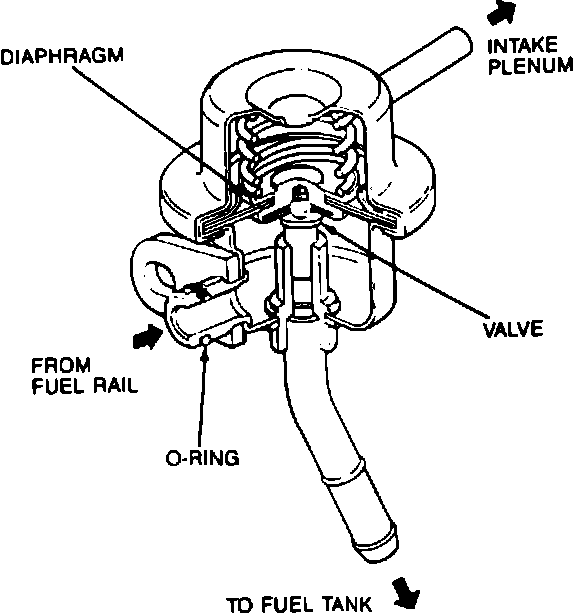
The fuel pressure regulator is attached to the fuel supply manifold assembly downstream of the fuel injectors. The fuel supply manifold regulates the fuel pressure supplied to the injectors. The regulator is a diaphragm operated relief valve in which one side of the diaphragm senses fuel pressure and the other side is subjected to intake manifold vacuum.
The fuel pressure regulator is controlled by the manifold vacuum and will always maintain fuel pressure at a constant 36.3 psi (250 kPa) above intake manifold pressure. When intake manifold vacuum is low (fuel demand high) spring pressure inside the regulator causes the valve to partially close, which increases fuel pressure in the fuel rail. When intake manifold vacuum is high (fuel demand low), vacuum acting on the diaphragm compresses the spring, opening the valve further. Return fuel flow increases, resulting in lower fuel pressure in the fuel rail.
The fuel pressure regulator is controlled by the ECA through a Pressure Regulator Control Solenoid Valve. This is accomplished by controlling the vacuum supply to the pressure regulator. Vacuum is restricted after the car is restarted or allowed to idle for approximately 120 seconds and the coolant temperature is above 158~F and/or the intake air temperature is above 68~F. This increases the fuel pressure.