Brake Shoe: Adjustments
The rear brakes are automatically adjusted while driving the vehicle. Manual brake adjustment is required only after the rear brake shoes and linings have been replaced, or if the rear brake strut and quadrant has malfunctioned and has been repaired or replaced. Perform the manual adjustment with the brake drum removed, using Brake Adjustment Gauge D81L-1103-A or equivalent and the following procedure.When adjusting the rear brake shoes and linings, check the front parking brake cable and conduit and parking brake rear cable and conduit for proper adjustment. Make sure the equalizer operates freely.
1. Raise the vehicle on a hoist. Position suitable safety stands under the vehicle. Remove the wheel and tire assembly. Remove the brake drum.
2. Use Rotunda Brake/Clutch/Service Vacuum 164-R3600 or equivalent to remove any dust present on the brake assembly.
3. Carefully remove the brake shoe hold-down springs. Using sandpaper, clean the rear brake shoe and lining-to-brake backing plate contact points while holding the rear brake shoe and lining away from the brake backing plate.
4. Check the brake backing plate for damage. If any damage is found, the brake backing plate must be replaced. Refer to procedure in this section. If no damage is found, apply a small amount of Silicone Brake Caliper Grease and Dielectric Compound D7AZ-19A331-A (Motorcraft WA-10) or equivalent meeting Ford specification ESE-M1C171-A to the points where the rear brake shoes and linings touch the brake backing plate. Be careful not to get the lubricant on the linings.
5. Install the brake shoe hold-down springs.
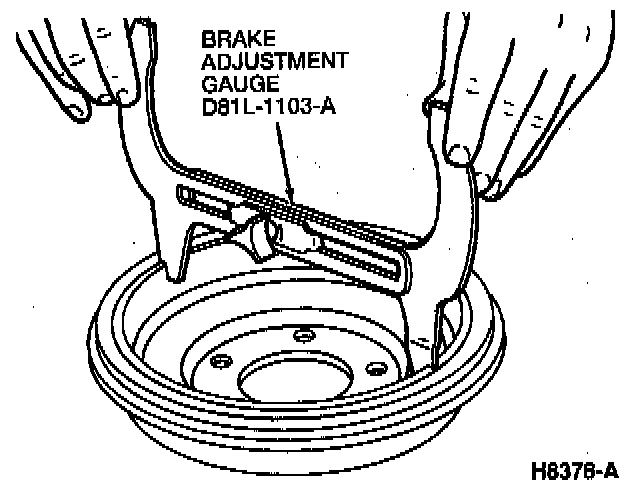
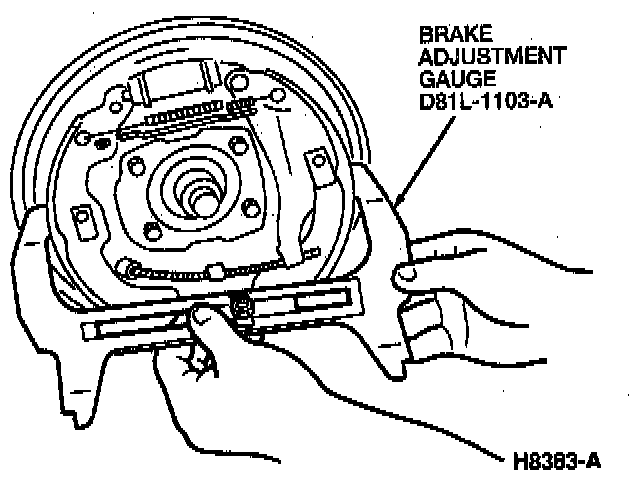
6. Using Brake Adjustment Gauge D81L-1103-A or equivalent measure the inside diameter of the brake drum braking surface and the outside diameter of the rear brake shoe and lining.
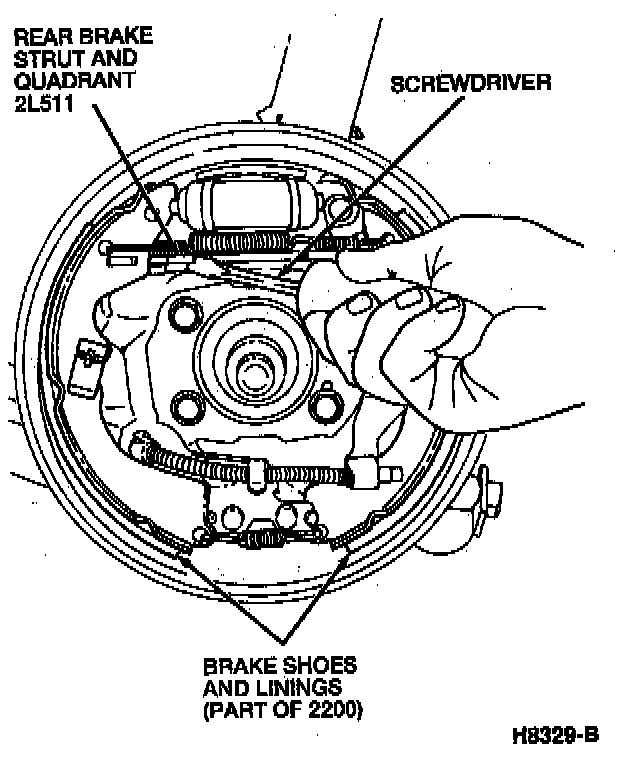
7. Insert a screwdriver into the knurled quadrant of the rear brake strut and quadrant. Adjust the rear brake shoes and linings to the same measurement as the brake drum.
8. Install the brake drum. Tighten the brake drum screws to 10-14 Nm (89-123 inch lbs.).
9. Install the wheel and tire assembly on the brake drum and tighten the lug nuts to 88-118 Nm (65-87 ft. lbs.). Remove the safety stands and lower the vehicle.
10. Complete the adjustment by sharply applying the brakes several times while driving the vehicle alternately forward and reverse.