All Except MTX Without ABS
1. Remove the brake master cylinder.WARNING: BRAKE FLUID CONTAINS POLYGLYCOL ETHERS AND POLYGLYCOLS. AVOID CONTACT WITH EYES. WASH HANDS THOROUGHLY AFTER HANDLING. IF BRAKE FLUID CONTACTS EYES, FLUSH EYES WITH RUNNING WATER FOR 15 MINUTES. GET MEDICAL ATTENTION IF IRRITATION PERSISTS. IF TAKEN INTERNALLY, DRINK WATER AND INDUCE VOMITING. GET MEDICAL ATTENTION IMMEDIATELY.
NOTE: The power brake booster-to-brake master cylinder push rod does not normally need adjusting unless the brake master cylinder has been changed. If it is adjusted too long, it will cause dragging brakes. If it is adjusted too short, it will cause a low brake pedal.
2. Mount the brake master cylinder in a soft jawed vise.
3. Loosen the brass holding screw on the Master Cylinder Gauge T92C-2500-A and retract the gauge rod. Attach the gauge to the power brake booster using the brake master cylinder nuts. Tighten the brake master cylinder nuts to 10-16 Nm (8-12 ft. lbs.).
4. Start the engine and let idle for approximately 15 seconds.
5. Push lightly on the end of the gauge rod, until the gauge rod just contacts the power brake booster push rod.
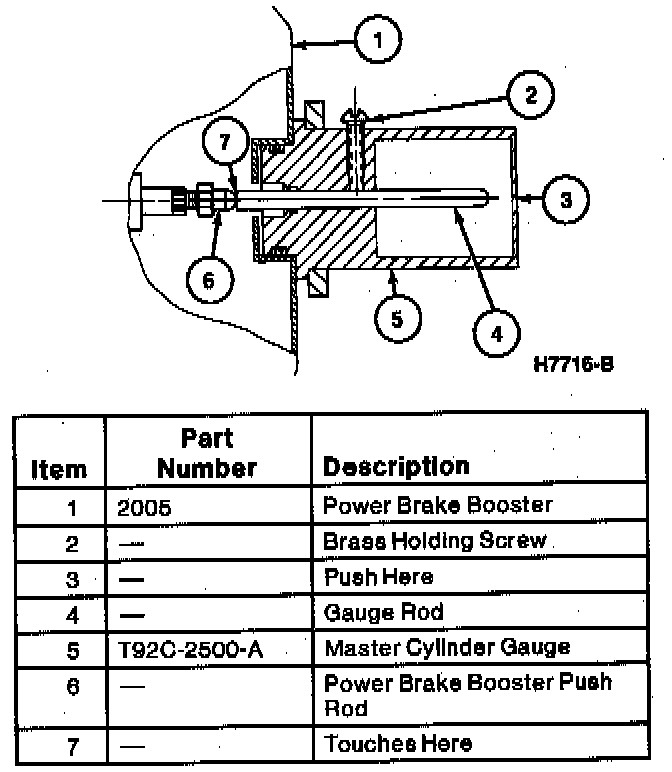
6. Tighten the brass holding screw, securing the gauge rod in place.
7. Remove Master Cylinder Gauge T92C-2500-A from the power brake booster. Turn the engine off.
CAUTION: Use extreme care when removing the gauge from the power brake booster. If the gauge rod setting is changed during removal, a faulty measurement will be recorded. This may lead to unnecessary adjustment of the power brake booster push rod.
Measuring Master Cylinder Gauge Rod:
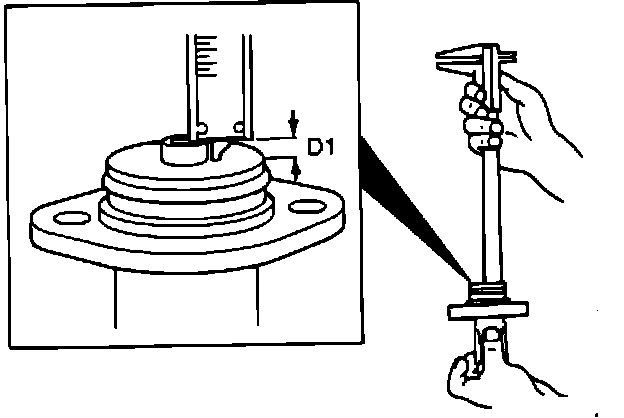
8. Use a depth gauge to measure and record the height (D1) of the master cylinder gauge rod as shown.
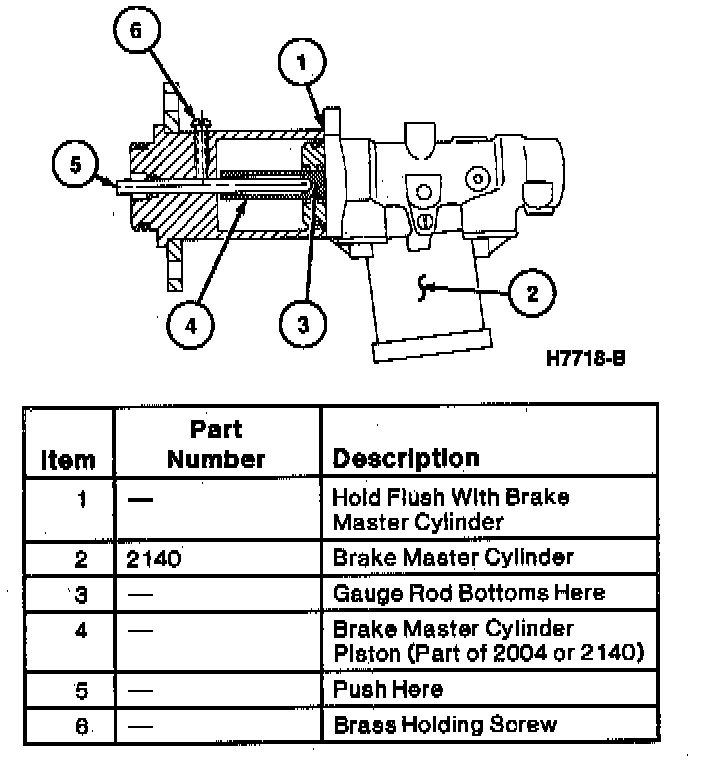
9. Loosen the master cylinder gauge brass holding screw and set the gauge on the brake master cylinder as shown.
10. Push lightly on the end of the gauge rod, until the end of the gauge rod just bottoms in the brake master cylinder piston. Tighten the brass holding screw.
CAUTION: Use extreme care when removing the gauge from the brake master cylinder. If the gauge rod setting is changed during removal, a faulty measurement will be recorded. This may lead to unnecessary adjustment of the power brake booster push rod.
11. Remove the master cylinder gauge from the brake master cylinder.
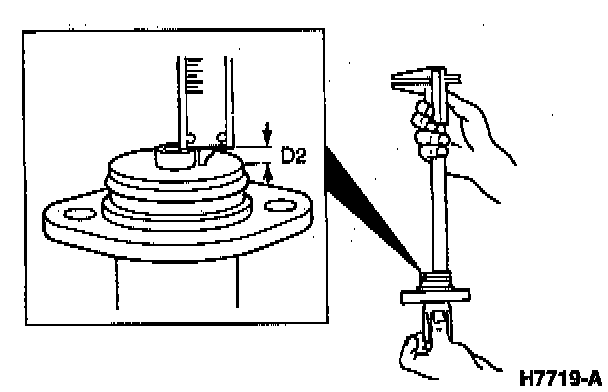
12. Use a depth gauge to measure and record the height (D2) of the gauge rod, as shown.
13. Determine the difference between measurements D1 and D2. If D2 is larger than D1, subtract D1 from D2. If D1 is larger than D2, subtract D2 from D1. Adjust the power brake booster push rod nut to lengthen or shorten the power brake booster push rod the amount equal to the difference between D 1 and D2.
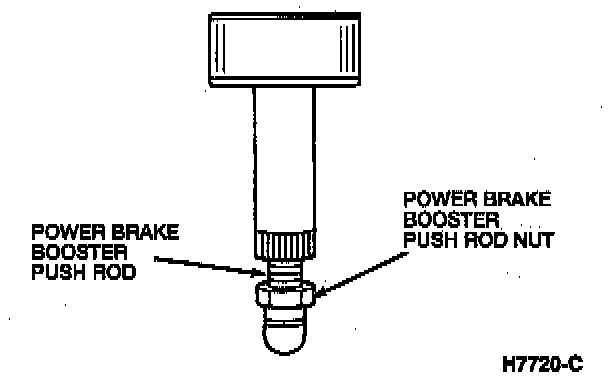
14. If the measurement of D1 is larger than D2, the power brake booster push rod must be lengthened. If the measurement of D2 is larger than D1, the power brake booster push rod must be shortened.
Example 1:
D1=0.0730 and D2=0.0650. 0.073-0.0650=0.0080.
The power brake booster push rod must be lengthened by 0.0080 inch.
Example 2:
D1=0.0650 and D2=0.0730. 0.0730-0.0650=0.0080.
The power brake booster push rod must be shortened by 0.0080 inch.
A second set of measurements may be helpful to ensure the accuracy of this test.