Cruise Control: Description and Operation
The speed control system consists of:^ Speed control actuator switch
^ Speed control amplifier
^ Clutch pedal position switch (CPP) (MTX)
^ Brake On/Off (BOO) switch
^ Speed control dump valve
^ Speed control servo
^ Speed control cable
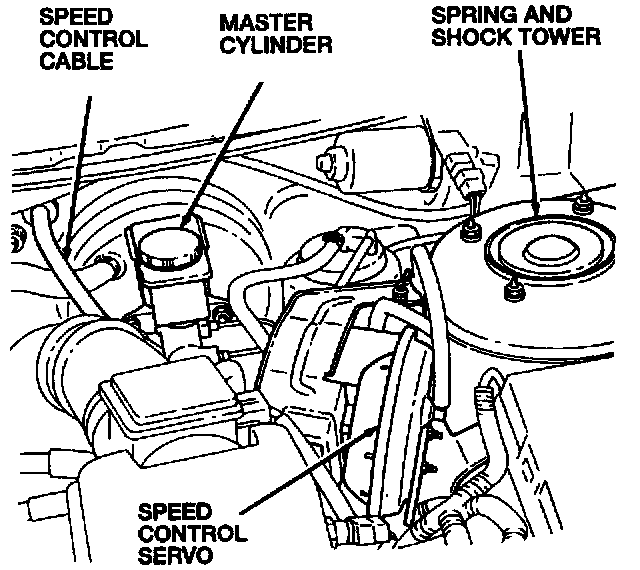
The speed control servo is an electronically controlled device that uses manifold vacuum to position the speed control cable. In turn, the position of the speed control cable controls engine speed.
The speed control amplifier reads input from the vehicle speed sensor (VSS) to determine vehicle speed. If activated, the sensor sends a signal to the speed control servo in order to maintain the set speed. By pressing, the ON portion of the speed control actuator switch the speed control amplifier begins to monitor vehicle speed. When the vehicle speed is above 48 km/h (30 mph), the speed control system is activated by pressing the set speed/accelerate speed (SET/ACC) portion of the speed control actuator switch.
Once the system is activated, acceleration is possible either by pressing the accelerator pedal or by pressing the SET/ACC switch. The vehicle may be decelerated by pressing the coast (CST) switch until the desired speed is reached. When the CST switch is released, the vehicle speed control will remain at that speed.
The speed control system is deactivated by performing one of the following:
^ Turning the speed control actuator switch to the OFF position.
^ Depressing the brake pedal.
^ Depressing the clutch pedal.
^ Placing the transaxle in neutral (M/T only).
If the OFF portion of the speed control actuator switch has not been pressed, pressing the RESUME (RSM) switch will signal the speed control amplifier to adjust the speed of the vehicle to the previously set speed.