Inflation
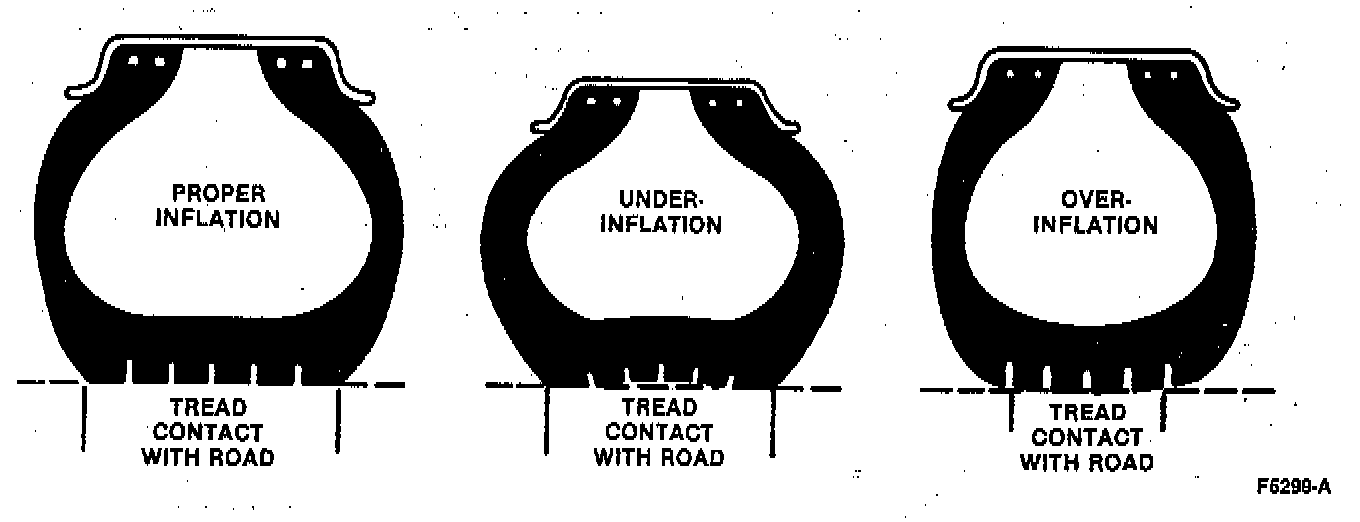
WARNING: Over- or under-inflated tires can reduce tire life, adversely affect vehicle handling, and possibly lead to a sudden failure that could result in the loss of vehicle control without warning.
CAUTION: Radial-ply tires have a highly flexible sidewall, which produces a characteristic sidewall bulge making the tire appear underinflated. This is a normal condition for radial-ply tires. Do not attempt to reduce this bulge by overinflating the tire.
^ The tire inflation pressure is carefully calculated to give the vehicle satisfactory ride and steering characteristics while not compromising long tire tread life.
^ A higher tire inflation pressure than the recommended pressure can cause a hard ride, tire bruising, carcass damage and rapid wear at the center of the tire. Low tire pressure can produce tire squeal, hard steering, rim dents, high temperatures and rapid wear on the outer edges of the tires. Unequal pressures can cause uneven braking and reduced handling.
^ A vehicle tire pressure decal, located on the inside edge of the LH door, gives the recommended cold tire inflation pressure. Check and adjust tire inflation pressures only when the tires are cold (vehicle has been parked for three hours or more) or the vehicle has driven less than 3.2 km (2 miles) at speeds below 64 km/h (40 mph).
^ Do not reduce inflation pressures if the tires are hot, or have been driven more than 3.2 km (2 miles) at speeds above 64 km/h (40 mph) as pressures can increase as much as 41 kPa (6 psi) over cold inflation pressures.
^ Be sure to reinstall the valve cap. It prevents air leaks and keeps dust and dirt out of the valve stems.
^ Check the condition of the wheels. Replace any wheel that is bent, cracked, severely dented, or has excessive runout. Also, check the condition of the tire inflation valve. Replace the valve if worn, cracked, loose, or leaking air.
^ It is mandatory to use only the tire size recommended on the tire chart attached to the vehicle. Larger or smaller tires can damage the vehicle and affect durability, and may cause the speedometer to read incorrectly. Be sure wheel sizes and offsets match those recommended for the tire in use.